

Portable sailboats and SUP sail kits are growing more popular among outdoor lovers, vacationers and water sports firms.
They need to be light, easy to move around and erect, and strong enough to cope with fluctuating wind and sea conditions – very different from traditional sailing rigs.
Consequently, many manufacturers are substituting aluminum tubing with carbon fiber tubes for masts, booms, support frames and structural components.
But how do you go about selecting the correct carbon fiber tube for a portable sailing system?
This article discusses the technical decisions on the carbon fiber mast design and the reasons why more marine product developers are resorting to carbon fiber composite structures.
We recently collaborated with a customer to produce a modular SUP sail kit for travel and recreational sailing.
The design requirements were simple.
· Light enough for one person to carry
· Corrosion resistant to salt water
· Quick assembly and disassembly
· High rigidity under wind load
· Saving space for delivery by car
The prototype was originally made from aluminum tubes.
The aluminum construction was strong enough, but the customer had a whole bunch of problems:
· Overweight in transport
· Noticeable mast bend in heavier wind conditions
· Less mobile at sea
· Higher total transit volume
After switching to carbon fiber tubes, which made the whole structure a lot lighter and improved the stiffness and handling performance.
Aluminum has been the material of choice for sailboat masts and light marine structures for many years because of the low cost of production, ease of fabrication and availability. But with the rise in popularity of portable sailboats, SUP sail kits and modular sailing systems, manufacturers face new challenges that traditional aluminum structures don’t always have a good answer for.
A portable sailing product needs to be light enough to be carried by one person, small enough to fit in a vehicle, and stiff enough to keep the sail efficient in different wind conditions, unlike a traditional sailboat. It would be nice to have all these things. For all of them at the same time you want a material with a greater stiffness to weight ratio than aluminum.
One of the major reasons designers are looking at carbon fiber tubes is their structural efficiency. The reduced weight of the mast also leads to a lower overall weight of the sailing system, which makes transport, assembly and handling very easy. For those who regularly haul gear from a parking lot to a beach or launch point, a few pounds here and there can make a world of difference to the overall experience.
Another important factor is stiffness Too much mast bend in portable sailing applications can hurt sail shape, wind efficiency and steering response. A mast that bends too much under load can impact the sailing performance and make the handling feel less predictable. Carbon fiber tubes are much stiffer for their weight so the designer can make lighter structures without sacrificing strength.
The corrosion resistance is also necessary for marine applications. Saltwater, humidity and long-term outdoor exposure can slowly compromise many metal parts. Carbon fibre composites don't rust and are usually more maintenance free. These properties make them suitable for portable sailing equipment, which is often exposed to harsh environment.
Another plus point is fatigue performance. These portable sail kits will be assembled, disassembled, transported and loaded many times over by wind during their service life. A well engineered carbon fiber tube will maintain its structural properties over many cycles to help improve long term reliability in demanding outdoor applications."
So many high end marine equipment manufacturers are turning to carbon fiber tube structures for their masts, booms, support frames and crossbars. Aluminum still makes sense for budget products, but carbon fiber is fast becoming the material of choice for brands looking to maximize portability, responsiveness and overall sailing performance.
| Feature | Carbon Fiber Tube | Aluminum Tube |
| Density | 1.5-1.6 g/cm³ | 2.7 g/cm³ |
| Weight | Very Low | Moderate |
| Stiffness-to-Weight Ratio | Excellent | Good |
| Corrosion Resistance | Excellent | Moderate |
| Fatigue Resistance | Excellent | Moderate |
| Portability | Excellent | Good |
The transition from aluminum to carbon fiber can reduce the structural weight by about 35–45% for a standard 2-meter portable mast, depending on the design.
This may be important to users who often take their gear to the beach, the lake or far-flung sailing destinations.
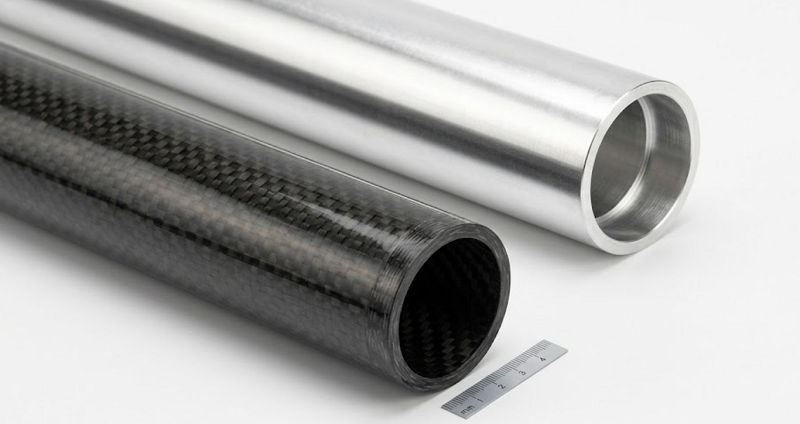
One of the most common questions we receive from marine equipment designers is:
"What diameter should we use for a portable sail mast?"
There is no universal answer.
The optimal diameter depends on:
· Sail area
· Mast height
· Wind load
· Connector design
· Transportation requirements
However, many portable sailing systems commonly use:
| Application | Typical Diameter |
| Small SUP Sail Kit | 25-30mm |
| Portable Sailboat Mast | 30-40mm |
| Larger Recreational Sail Systems | 40-60mm |
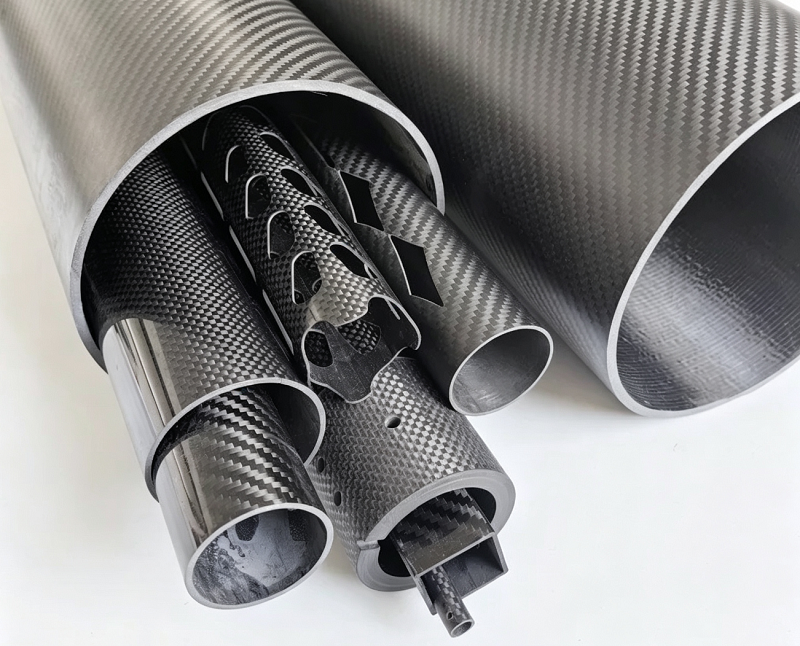
Increasing tube diameter generally improves bending stiffness more effectively than simply increasing wall thickness.
This often allows designers to maintain strength while minimizing weight.
Many designers assume thicker walls automatically create a stronger mast.
In reality, excessive wall thickness can add unnecessary weight without delivering proportional performance benefits.
Typical wall thicknesses used in portable marine applications include:
· 1.0 mm
· 1.5 mm
· 2.0 mm
· 2.5 mm
The correct selection depends on:
· Mast length
· Expected wind conditions
· Connector design
· Safety factor requirements
Engineering analysis should always consider both stiffness and weight rather than focusing on strength alone.
Interestingly, many failures in portable sail systems do not occur in the carbon fiber tube itself.
They occur at:
· Drilled holes
· Connector interfaces
· Bonded inserts
· Telescopic joints
For this reason, proper connector design is essential.
Common reinforcement solutions include:
· Additional laminate layers
· Bonded aluminum inserts
· Reinforced end sections
· Precision CNC-machined fittings
When designed correctly, these reinforcement methods can significantly improve durability and assembly reliability.
Even a well-designed mast can experience problems if manufacturing quality is inconsistent.
For portable sailing products, critical quality factors include:
· Tube straightness
· Diameter tolerance
· Wall thickness consistency
· Drilling accuracy
· Surface finish quality
· Batch-to-batch repeatability
Small variations may seem insignificant individually, but they can create assembly difficulties when hundreds or thousands of products are produced.
This is particularly important for modular sail kits that require interchangeable components.
Carbon fiber tubes are widely used in:
Provide lightweight, high-stiffness support for sail systems.
Improve sail control while reducing structural weight.
Connect inflatable platforms and modular sailing structures.
Distribute loads while maintaining portability.
Allow compact storage and fast deployment.
As portable sailing products continue evolving, manufacturers are under increasing pressure to improve:
· User experience
· Portability
· Assembly speed
· Product appearance
· Performance
Carbon fiber tubes help achieve all of these objectives simultaneously.
For many modern portable sailboat and SUP sail kit brands, carbon fiber is no longer simply a premium material choice.
It has become a practical engineering solution for creating lighter, stiffer, and more transportable marine products.
When constructing a portable sailboat, SUP sail kit, inflatable sailing platform or a lightweight marine construction, you usually need more than just a standard carbon fiber tube. Parameters such as mast stiffness, tube diameter, wall thickness, connector design, assembly frequency and transportation requirements influence the final performance of the product.
At DroneCarbon we partner with manufacturers, product designers and engineering teams to engineer solutions of carbon fiber tubes built for exclusive marine applications. No matter if you are building a lightweight mast system, a modular sail frame, a telescopic support structure or a portable sailing platform – we can help you from prototype to series production.
We can custom produce to tube diameters and wall thickness, cut to length, CNC drill, slot machine, bond inserts, build telescopic tube assemblies and provide other value added machining services. In these projects we pay special attention to dimensional consistency, straightness control, drilling accuracy and quality stability from batch to batch.
For many years we have supplied carbon fibre tubes for a wide range of lightweight structural applications where weight reduction, stiffness and long term durability have been critical. Whether you want to make your product more portable, reduce the overall weight of the system, improve sailing performance or make assembly easier our engineering and manufacturing team can help you find the right carbon fiber tube answer for your project.
If you are designing a portable sailboat, SUP sail kit, inflatable sailing system or any other kind of marine related product please contact us to discuss your technical requirements, tube specifications and custom carbon fiber cnc machining needs.