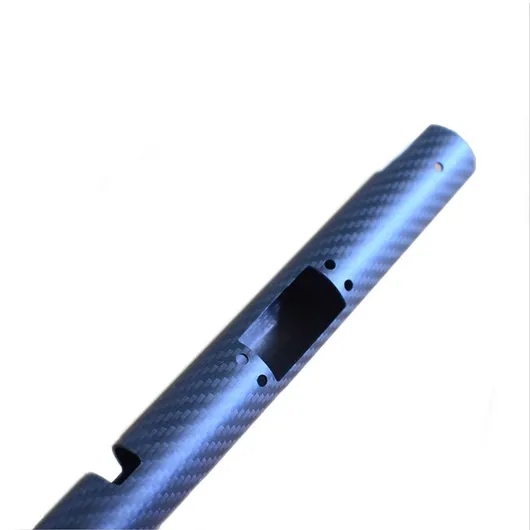

Looking for precision without compromise? High-quality 3K carbon fiber tubes are essential for aerospace, UAVs/drones, robotics, sports, and medical devices due to their lightweight
and high strength. However, post-manufacturing modifications like precision drilling for
mounting holes can be highly challenging.
Conventional drilling often leads to costly delamination, micro-cracks, and fiber tear-out
due to weak interlayer bonding.
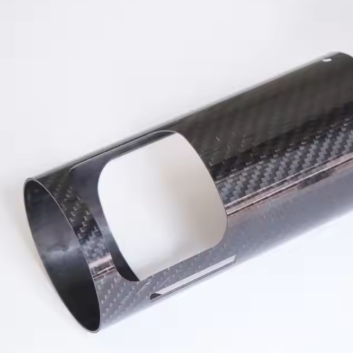
Our professional Carbon Fiber CNC Machining Service solves this. Using specialized
diamond-coated tooling and advanced CNC routing, we deliver clean, burr-free holes
with zero structural damage. Whether you need rapid prototyping or high-volume
production, we bring your 2D/3D designs to life.
Capabilities: Precision carbon fiber tubec cutting, slotting, and drilling.
Supported Shapes: Round, square, rectangular, oval, and custom shape.
Global Reach: Rapid prototyping and worldwide shipping.
[Get a Free Quote for Your Custom Solution Now!]

We don't just cut tubes; we deliver ready-to-assemble structural components. Our workshop
is equipped with advanced CNC machinery specifically optimized for composite materials,
allowing us to offer a comprehensive range of precision services:
Precision CNC Drilling & Hole Machining: We process high-accuracy holes ranging from 0.2mm to 50mm in
diameter (from micro to large-scale apertures).
Advanced Slotting & Milling: Custom routing for linear slots, keyways, custom profiles, and weight-reduction
cutouts, providing clean wire-routing channels with no interlayer damage.

Carbon Fiber Tube Cutting Length: Clean, perpendicular cuts tailored to any specified length. We utilize
high-pressure waterjet cutting to completely eliminate edge delamination and fiber tear-out.

Specialized Hole Types: Beyond standard drilling, we support advanced geometries including Tapered,
Countersunk, Stepped holes, and Counterboring to ensure perfect flush-fits for rivets, screws, and fasteners.
Threading & Tapping: Because direct threading can destroy carbon fiber structures,
we utilize advanced internal/external threading insert technologies to provide
high-strengththreaded connections. We masterfully integrate metal threaded inserts and
press nuts into the tubes.


Metal-to-Carbon Adhesive Bonding: Providing one-stop assembly services. We securely bond
aluminum, titanium, or stainless steel inserts, brackets, and joints to carbon fiber tubes
using aerospace-grade epoxies.

CFRP Specifications: 3K, 6K, 12K carbon fiber tubes

Weave Types: UD (Unidirectional), Twill, Plain, forged, surface finishes

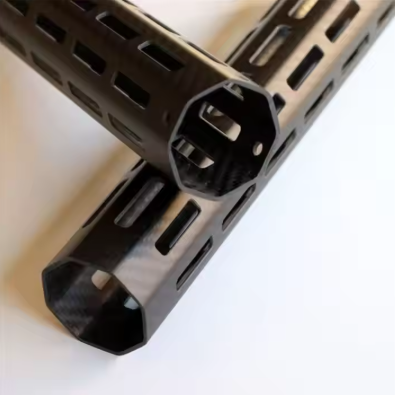
Custom Carbon Tube Shapes: Round, Square, Rectangular, Oval, Hexagonal, Octagonal and custom other shapes.
Size range for shape carbon fiber tube:
Diameter: 4mm–500 mm+
Wall thickness: 0.5 mm+
Length: Up to 6m (custom cutting length available)

3. Target Industries
We implement a rigorous, multi-stage Quality Assurance (QA) protocol for every
carbon fiber tube drilling and machining project to ensure industrial-grade precision
and long-term durability.
We utilize advanced inspection equipment to guarantee that every hole and cut matches
your engineering blueprints.
Hole Position & Pitch Tolerance: standard tolerance is about ±0.1mm
(stricter tolerances up to ±0.05mm available upon request).
Hole Diameter Tolerance: Controlled about ±0.1mm using specialized diamond-coate drills.
Cutting Length Tolerance: ±0.2mm to ±0.5mm depending on wall thickness.
Inspection Tools: Full-dimension checks via CMM (Coordinate Measuring Machine),
2.5D Optical Measuring Systems, and digital calipers.
Carbon fiber is prone to hidden internal damage. Our process eliminates these risks:
Delamination & Tear-out Prevention: Guaranteed zero delamination and zero fiber
breakout. We achieve this by optimizing CNC spindle speeds (high RPM) and
feed rates, combined with sacrificial backing materials during drilling.
Burr-Free Edges (Deburring Process): Every single machined carbon fiber tubeundergoes a meticulous post-processing phase. We use deburring knives and sand
paper to remove any fuzzy fibers, ensuring 100% clean holes and smooth cut edges.
Visual & Microscope Inspection: Every drilled hole undergoes 10x to 50x magnification
optical inspection to detect micro-cracks or interlayer bonding issues before shipping.
Go/No-Go Gauge Testing: We use custom pin gauges to verify every hole's clearance.
Hardware Matching: If required, we perform pre-assembly fit tests with specified rivets,
bolts, or metal inserts to ensure 100% field compatibility.
CNC customized carbon fiber tubes for toys
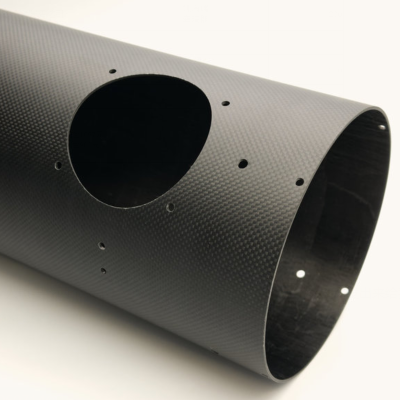
Carbon fiber tube for skywatcher
carbon fiber tubes for delat robot arm
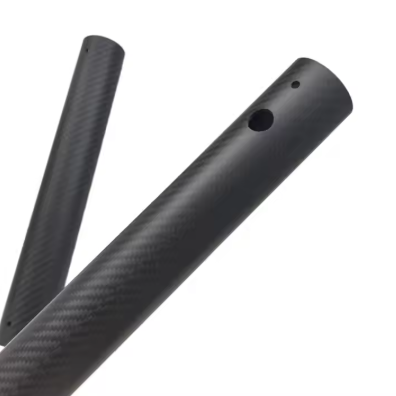
Carbon fiber tube for fishing rod

Drilling holes in carbon fiber tubes is typically done for specific functional or manufacturing purposes. However, this should never be undertaken lightly because it significantly compromises the tube's structural integrity and performance. The main reasons for drilling holes include:
Mechanical Fastening: The most common reason. Holes are drilled to allow bolts, screws, pins, or rivets to pass through the tube wall, enabling it to be connected to other components (like metal fittings, brackets, another tube, or panels).
Dowel Pins: Used for precise alignment of multiple components.
While carbon fiber is inherently lightweight, in extremely weight-sensitive, high-performance applications (e.g., top-tier racing, aerospace), designers might drill holes in non-critical load-bearing areas or regions with very low stress levels to shed marginal weight. This requires extremely careful analysis to ensure primary structural function isn't compromised and is generally not the primary reason.
Cure Venting/Drainage: During manufacturing (e.g., filament winding or pultrusion), small holes may be pre-formed or drilled to act as vents. These allow air and excess resin to escape during the curing process, ensuring proper resin impregnation, curing quality, and reducing internal defects.
Mold Location/Fixturing: Holes may be used to secure mandrels or other tooling during the manufacturing process.
Machining Datums: Serve as reference holes for subsequent machining or assembly steps.
Routing Pass-Throughs: For routing wires, hydraulic lines, pneumatic lines, etc., through the internal bore of the tube.
Drainage/Vent Holes: To prevent water or condensation from accumulating inside the tube cavity (e.g., a small hole at the bottom of a bicycle seatpost) or to equalize air pressure in sealed tubes.
Mounting Accessories: For attaching sensors, brackets, cable clips, trim pieces, or other functional/auxiliary components.
Acoustic Tuning: In rare, specific applications, holes might be used to modify acoustic properties.
Drill Bit:
Using
a small drill bit for manual drilling is a common method. However,
during the drilling process, the carbon fiber board may be cut by the
drill bit, leading to edge delamination. To prevent this, applying
lubricant on the surface of the carbon fiber board can reduce heat and
friction while making it easier for the drill bit to penetrate.
File:
A
file is another manual drilling method. Unlike a drill bit, a file can
create holes directly rather than through cutting. The downside is its
lower efficiency, making it unsuitable for scenarios requiring a large
number of holes.
Laser:
A
laser is a highly precise drilling tool capable of producing very small
and high-precision holes. However, lasers are generally expensive and
require specialized equipment.
CNC Machine:
A
CNC (Computer Numerical Control) machine is an automated drilling
device. It can programmatically create holes of various shapes and sizes
with high efficiency and precision.
Electric Drill:
An
electric drill is a versatile tool in mechanical drilling, capable of
making holes of different sizes and shapes. However, compared to lasers
and CNC machines, electric drills have slightly lower precision and
efficiency.
Drill bits, files, lasers, CNC machines, and electric drills are all common tools for drilling holes in carbon fiber boards. When selecting a drilling method, factors such as requirements, precision, and cost-effectiveness should be considered. For small-scale needs, manual drilling may be more suitable, while mechanical drilling is a better choice for large-scale operations.
Carbon fiber reinforced polymer (CFRP) tubes are widely used in aerospace, UAVs, and medical devices for their high strength-to-weight ratio, but present unique machining challenges:
Weak interlayer bonding causes ply separation during drilling, compromising structural integrity
Most prevalent at exit side, visible as fiber lifting or edge splintering

CFRP's abrasive nature generates sharp protrusions that impair assembly precision
Conventional HSS drill bits accelerate burr formation through rapid wear
Anisotropic properties cause preferential fiber breakage along grain direction
Manual feed rate inconsistencies exacerbate this issue
Carbon fibers' abrasiveness dulls standard bits after ≈20-30 holes
Worn tools cause dimensional deviations (±0.1mm+) and increased surface roughness
Improper fixturing leads to rotational scratches, particularly problematic for medical/optical applications
Drilling holes in carbon fiber tubes must be approached with extreme caution because:
Stress Concentration: Hole edges are natural stress concentrators. Under load (especially tension, bending, or torsion), the stress around the hole will be much higher than elsewhere on the tube wall, greatly increasing the risk of failure initiation (e.g., cracking, delamination) starting there.
Fiber Continuity Disruption: Drilling cuts through the continuous carbon fiber bundles, which are the primary load-bearing elements in the composite. This significantly weakens the area.
Delamination Risk: The cutting forces, heat generation, or improper technique during drilling can easily cause delamination (separation between layers) around the hole, severely damaging structural integrity.
Burrs and Edge Damage: Drilling can produce burrs, tearing, or micro-cracks at the hole edge, which themselves can become initiation points for failure.
Careful Design:
Avoid drilling in high-stress areas whenever possible.
If holes are essential, their location and size must be determined through detailed structural analysis (e.g., Finite Element Analysis - FEA) to ensure residual strength meets requirements.
Consider hole reinforcement measures like local ply build-up, increased wall thickness, or using metal/composite bushings/washers.
Ensure adequate hole spacing and edge distance.
Professional Machining:
Use sharp, dedicated carbide (tungsten steel) or diamond-coated drill bits. Standard twist drills easily cause tearing and delamination.
Employ appropriate drilling parameters: Low speed with high feed rate or high speed with low feed rate. Avoid generating excessive heat.
Secure Support: The tube must be firmly supported during drilling, especially at the exit point, to prevent delamination and breakout.
Deburr/Chamfer: Carefully remove burrs and sharp edges after drilling, typically by chamfering.
Cooling: Use compressed air cooling if needed; avoid liquid coolants (risk of contamination or wicking between layers).
Professional Guidance: It is strongly advised to consult a composites engineer or experienced manufacturer. For critical structural components, hole location, size, and the drilling process itself are best determined and performed by professionals.
Holes are drilled in carbon fiber tubes primarily to meet needs for connection/assembly, specific functionality, or particular manufacturing processes. However, drilling inevitably weakens the tube and introduces failure risks, particularly stress concentration and delamination. Therefore, drilling must not be done casually. It requires rigorous design analysis, selection of appropriate hole location and size, use of specialized drilling techniques and tools, and potentially hole reinforcement. For important structural components, always seek professional advice and services. Unless there is a clear and necessary functional requirement, avoid drilling holes in carbon fiber structural members.