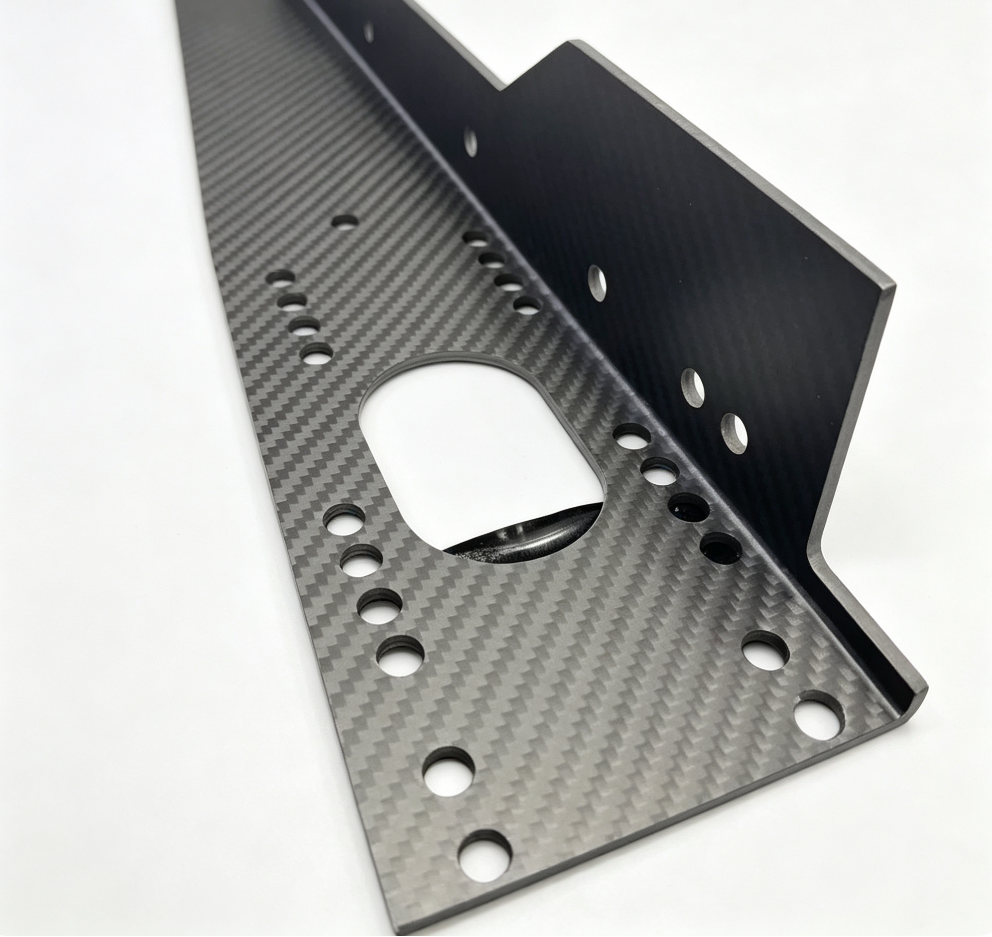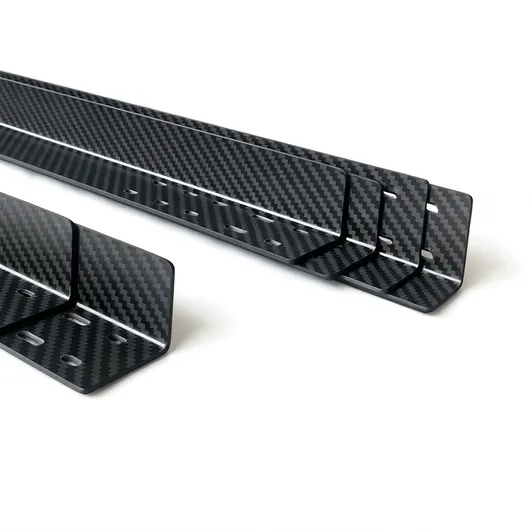
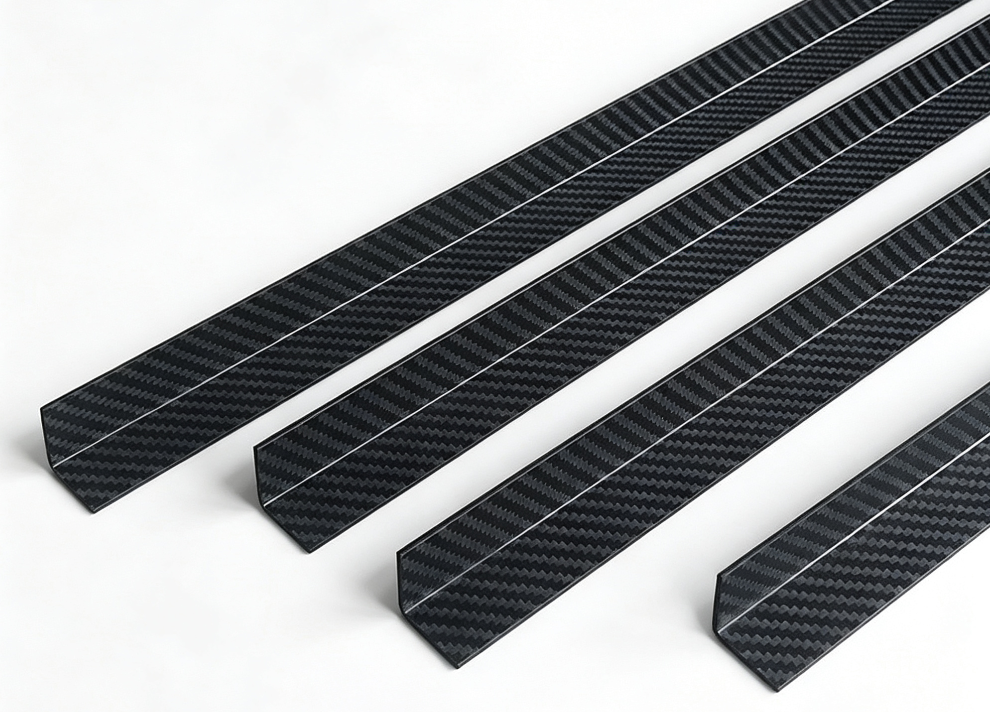
Carbon Fiber Angle, also known as a Carbon Fiber L Profile or Carbon Fiber L Shape, is a lightweight structural component manufactured in a precise 90° angle configuration. It is widely used as a joining, mounting, reinforcing, or edge-protection element in lightweight composite structures.
Our carbon fiber angles are manufactured using multiple layers of premium carbon fiber prepreg and epoxy resin systems. The laminate is carefully arranged in a balanced 0°/90° fiber orientation, allowing the profile to achieve excellent stiffness and strength in both directions. This layup design provides a well-balanced combination of mechanical performance, dimensional stability, machinability, and cost efficiency.
Unlike pultruded profiles that primarily carry loads in a single direction, a 0°/90° laminated carbon fiber angle offers more uniform structural properties, making it suitable for brackets, corner reinforcements, frame assemblies, and structural joining applications.
The angles are cured under controlled temperature and pressure conditions to achieve a low void content, smooth surface finish, and consistent dimensional accuracy. The result is a lightweight profile with excellent rigidity, impact resistance, corrosion resistance, and long-term durability.
Finished with a visible carbon fiber weave pattern in either twill or plain weave, carbon fiber angles provide both structural performance and a premium appearance. The smooth surface inside and outside the angle also makes them easy to cut, drill, bond, and CNC machine.
Typical applications include lightweight brackets, frame reinforcements, equipment enclosures, drone structures, robotic systems, automation equipment, motorsport components, marine interiors, and scientific instruments.
Custom lengths, leg dimensions, wall thicknesses, fiber architectures, and surface finishes are available upon request.
Carbon fiber angles are one of the most versatile structural profiles used in lightweight engineering. Their 90° geometry allows them to perform multiple functions within an assembly, including joining panels, reinforcing corners, supporting components, and protecting exposed edges.
Carbon fiber angles are commonly used to reinforce corners and panel intersections without adding significant weight to the structure. This makes them particularly valuable in weight-sensitive applications such as drones, robotics, and motorsport equipment.
L profiles can be bonded or mechanically fastened to connect carbon fiber sheets, aluminum panels, composite structures, and enclosure assemblies. They provide a simple and effective method for creating rigid 90° joints.
The combination of carbon fiber stiffness and angle geometry creates a highly rigid profile that can be used as mounting brackets, equipment supports, and structural attachment points.
Carbon fiber angles can be cut, drilled, slotted, and CNC machined to meet specific assembly requirements. They can also be bonded using structural adhesives or assembled using mechanical fasteners.
Unlike metal angles, carbon fiber angles combine engineering performance with a premium composite appearance. This allows them to serve as both structural components and visible finishing elements in high-end products.
Carbon fiber angles do not rust and are suitable for environments where aluminum or steel components may experience corrosion or long-term degradation.
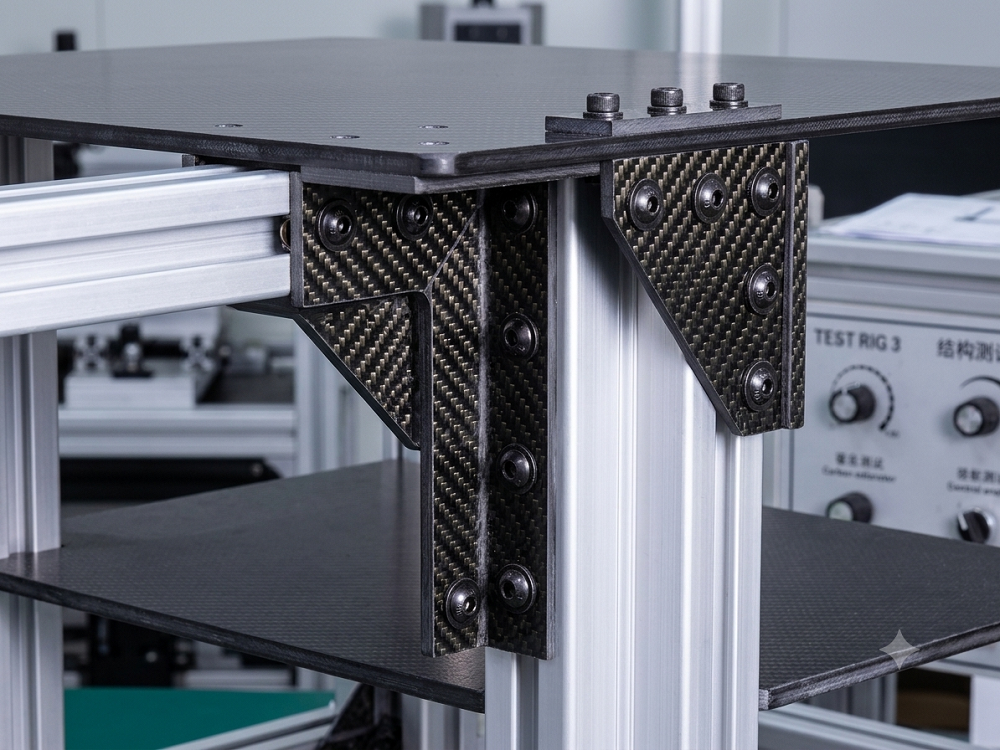
Carbon fiber angles are widely used in UAV and drone structures where weight reduction directly improves flight performance.
Typical applications include:
Drone frame reinforcement
Payload support brackets
Camera mounting structures
Ground station equipment
UAV structural assemblies
Robotic systems require lightweight yet rigid structural components.
Carbon fiber angle profiles are commonly used for:
Robotic arm structures
End effector supports
Mobile robot frames
Automation equipment assemblies
High-speed motion systems
Industrial automation equipment benefits from the reduced mass and high stiffness of carbon fiber structural angles.
Applications include:
Machine frames
Conveyor systems
Equipment supports
Packaging machinery
Vision inspection systems
Medical device manufacturers use carbon fiber angle profiles for:
Imaging equipment
Diagnostic devices
Rehabilitation systems
Laboratory automation equipment
Carbon fiber composite angles help reduce structural weight while maintaining exceptional strength.
Applications include:
Aircraft interiors
Satellite structures
Aerospace instrumentation
Ground support equipment
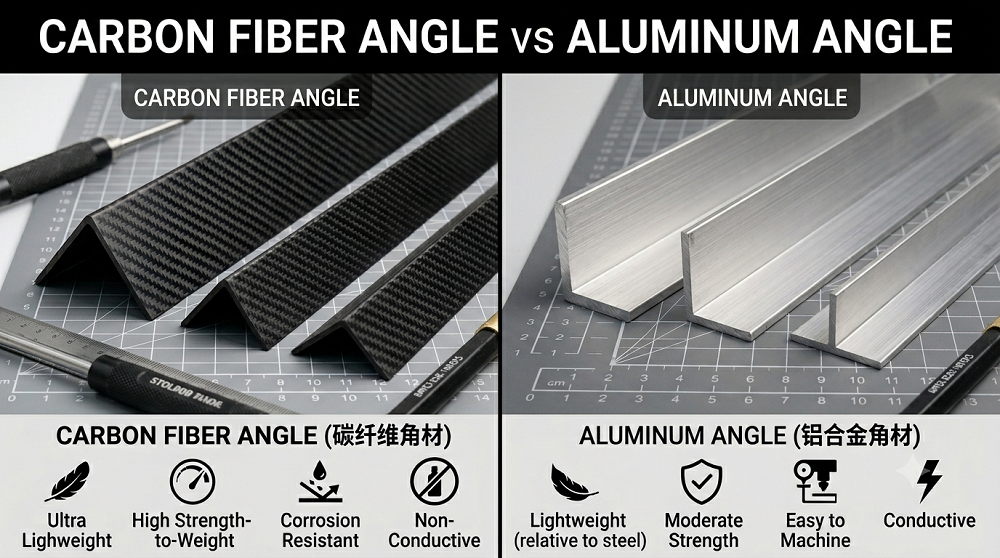
Carbon fiber angles and aluminum angles are commonly used for brackets, frame assemblies, panel reinforcement, and structural support. While both materials can perform similar functions, they offer very different advantages depending on the application.
Property | Carbon Fiber Angle | Aluminum Angle |
Weight | Excellent | Good |
Stiffness-to-Weight Ratio | Excellent | Moderate |
Corrosion Resistance | Excellent | Good |
Fatigue Resistance | Excellent | Moderate |
Thermal Expansion | Very Low | Higher |
Appearance | Premium Composite Finish | Metallic Finish |
Machinability | Good | Excellent |
Material Cost | Higher | Lower |
The biggest advantage of carbon fiber angles is their exceptional stiffness-to-weight ratio.
For weight-sensitive structures such as drones, robotic systems, automation equipment, motorsport components, and scientific instruments, reducing weight often improves overall performance. A lighter structure can increase efficiency, reduce energy consumption, and improve dynamic response.
Carbon fiber angles also provide excellent corrosion resistance and dimensional stability. Unlike aluminum, carbon fiber does not oxidize and experiences minimal thermal expansion, making it ideal for applications that require long-term accuracy and reliability.
In addition, the woven carbon fiber surface provides a premium appearance, allowing the profile to serve both structural and cosmetic purposes.
Aluminum angles remain a practical solution for many general-purpose applications.
If weight reduction is not critical and cost is the primary concern, aluminum angles can often provide a more economical option. They are also easier to machine, weld, and source in large quantities.
For shelving systems, building structures, general industrial equipment, and non-performance-critical assemblies, aluminum angles may be the preferred choice.
Choose Carbon Fiber Angles if you need:
Lightweight structural components
High stiffness and rigidity
Corrosion resistance
Low thermal expansion
Premium appearance
Improved performance in moving systems
Choose Aluminum Angles if you need:
Lower material cost
Simple fabrication and welding
High-volume production
General-purpose structural support
For applications where every gram matters, such as UAVs, robotics, automation systems, and motorsport engineering, carbon fiber angles often provide performance advantages that traditional aluminum profiles cannot match.
Looking for a reliable custom carbon fiber angle manufacturer?
We manufacture carbon fiber angles and CNC machined carbon fiber L profiles in our own factory. All production processes—including layup, molding, curing, and CNC machining—are completed in-house.
We produce both standard and custom carbon fiber angles based on engineering drawings or sample requirements.