When adding a logo, text, serial number, or functional marking to a custom carbon fiber part, two methods are often considered: silk screen printing and laser engraving.
But which one should you choose?
There is no single process that is best for every carbon fiber component. The right choice depends on what you want to mark, whether color is required, how the part will be used, and whether the carbon fiber surface itself can be altered.
For many custom CNC carbon fiber parts, silk screen printing is suitable when visible logos, colored text, or functional labels are required. Laser engraving or marking may be considered when a permanent, non-colored identification is needed, but the effect of laser processing on the CFRP surface must also be evaluated.
This guide compares the two methods to help engineers and buyers choose a suitable carbon fiber marking and logo solution.
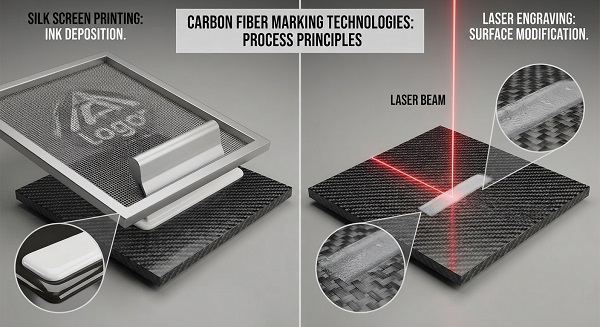
Silk screen printing, also known as screen printing, transfers ink through a prepared mesh screen onto the surface of a part.
For carbon fiber components, it can be used to add:
· Company logos
· Product names
· Button labels
· Symbols and icons
· Numbers
· Operating text
· Identification markings
· Other functional graphics
Unlike engraving, silk screen printing on carbon fiber adds the required graphic to the surface without intentionally removing carbon fiber material.
This makes it particularly useful for visible carbon fiber panels and CNC machined parts where the original carbon fiber weave and surface need to remain intact.
It is not limited to branding.
For example, a CNC machined carbon fiber control panel may require holes and cutouts for switches together with printed text identifying the function of each button. A sim racing button plate may require both a brand logo and functional labels.
In these applications, screen printing becomes part of the finished component rather than simply a decorative logo.
Laser engraving uses concentrated laser energy to modify or remove material from the surface and create a visible mark. In general manufacturing, laser engraving is commonly used for logos, part numbers, serial numbers and identification information.
However, laser engraving carbon fiber is different from laser engraving aluminum or stainless steel.
Carbon fiber reinforced polymer (CFRP) consists of carbon fibers held within a polymer matrix, commonly an epoxy resin. These materials react differently to heat. Research into laser processing of CFRP shows that improper thermal input can create a heat-affected zone, resin degradation and delamination.
Therefore, the question should not simply be:
“Can carbon fiber be laser engraved?”
A better question is:
“Can the required marking be produced without unnecessarily affecting the carbon fiber laminate or finished surface?”
For structural carbon fiber components, especially, deeper laser engraving should not automatically be treated in the same way as laser marking a metal component.
Feature | Silk Screen Printing | Laser Engraving |
Method | Adds ink to the surface | Modifies/removes surface material |
Color options | Multiple colors possible | Usually limited |
Carbon fiber surface | Does not intentionally remove laminate material | Surface is altered |
Colored logos | Very suitable | Limited |
Text & functional labels | Very suitable | Possible |
Serial numbers / IDs | Possible | Useful for permanent identification |
Detailed branding | Suitable | Depends on contrast and surface |
Structural CFRP consideration | No material removal | Laser parameters must be evaluated |
Best suited for | Logos, text, labels, visible graphics | Permanent non-colored markings where the process is validated |
The most important difference is therefore not simply appearance.
It is whether you want to add information onto the carbon fiber surface or physically modify that surface to create the mark.

For many custom carbon fiber panels and visible CNC components, carbon fiber silk screen printing is a practical choice.
A laser cannot reproduce a colored brand logo in the same way as printing.
If your product requires white, red, blue, yellow or another specified logo color against a black carbon fiber surface, silk screen printing provides much more flexibility.
Color contrast should be considered during design because the carbon fiber substrate is naturally dark. General screen-printing design guidance also recommends considering ink color against the underlying part surface to maintain readability.
Some carbon fiber components require much more than a logo.
Consider a control panel with:
POWER — START — MODE — UP — DOWN
or a sim racing button plate with multiple controls.
In this situation, silk screen printing can place text, icons and functional information around the CNC-machined holes and cutouts.
Carbon fiber is frequently selected not only for mechanical properties but also for its distinctive woven appearance.
For a visible component, customers may want to maintain the 3K carbon fiber weave while adding graphics on top.
Screen printing can achieve this without using the marking process to cut into the laminate itself.
Laser processing may be considered when the application requires a permanent, non-colored mark, such as:
· Part identification
· Serial numbers
· Simple logos
· Production codes
· Traceability information
It can also be particularly useful on metal components assembled with carbon fiber parts.
For example, if a finished assembly contains a CNC carbon fiber plate and an aluminum mounting component, silk screen printing may be used for the visible graphics on the carbon fiber while laser marking is used for identification on the aluminum component.
That is why the marking method should be selected according to the material and function of each component, rather than applying one process to every part.
For carbon fiber itself, laser parameters and material construction need to be considered carefully because excessive thermal exposure can affect the resin matrix and laminate. Industrial laser guidance similarly identifies avoiding damage to the fiber composite as a key challenge when processing CFRP.
Yes, and this is especially useful for custom carbon fiber parts manufactured from drawings.
A typical production sequence may be:
Carbon Fiber Sheet → CNC Cutting → Drilling / Countersinking / Chamfering → Edge Finishing → Silk Screen Printing → Inspection
This allows the printing layout to be considered together with the CNC machining.
For example, a logo or text may need to maintain the correct distance from:
· Mounting holes
· Countersunk screws
· Slots
· Switch cutouts
· Panel edges
· Other assembled components
Instead of purchasing a carbon fiber sheet, finding another supplier for CNC machining, and then arranging printing separately, these processes can be coordinated as part of the same custom component project.
Choose silk screen printing when your priority is:
colored logos, visible branding, text, symbols, button labels or functional graphics while retaining the original carbon fiber surface.
Consider laser marking or engraving when you require:
permanent non-colored identification or serialization and the marking process has been confirmed as suitable for the particular material and component.
For structural CFRP parts, do not choose deep laser engraving purely because the mark needs to be permanent. The potential effect on the laminate should be evaluated first.
And if the product combines carbon fiber with aluminum or stainless steel components, there is no requirement to use the same marking process everywhere. Different processes can be selected for different materials.
For custom carbon fiber projects, logo application is often only one step of the manufacturing process.
We can manufacture carbon fiber sheets and provide CNC carbon fiber machining and silk screen printing based on customer drawings, including custom profiles, holes, slots, countersunk holes, chamfered edges, logos, text and functional markings.
If you already have a carbon fiber part drawing, send us:
DXF / DWG / STEP file + quantity + surface requirement + logo/text artwork + printing color and position.
We can review the machining and marking requirements together before production.

Yes. Silk screen printing can be used to add logos, text, symbols and functional markings to suitable carbon fiber surfaces. Final print quality depends on factors including the surface condition, ink compatibility, graphic design and application environment.
Carbon fiber composites can be processed by lasers, but CFRP is a fiber-reinforced polymer rather than a homogeneous metal. Laser parameters need to be controlled because excessive thermal input can damage the resin matrix or composite structure.
For a visible colored logo or text, silk screen printing is often more suitable than laser engraving because printing allows the required color to be applied onto the carbon fiber surface.
Yes. For custom carbon fiber panels, CNC machining can be completed first, followed by edge finishing and silk screen printing according to the required artwork and position.
For the carbon fiber component, provide the relevant DXF, DWG or STEP drawing. For the printed content, provide the logo/text artwork together with its required dimensions, position and color.